
Anyone who has waited on a station platform – whether during rush hour or at a more restful time of day – knows there’s little to do but look around and read whatever is in front of them. This is why train advertising has remained such a dependable part of UK advertising. From busy inner-city stations to quiet regional platforms, rail environments put brands in front of commuters, tourists, students and business travellers at a point when they’re paying attention.
What is train advertising?
Train advertising is the umbrella term for paid advertising across the UK rail network: on train advertising (the formats found inside and on the train itself) and railway station advertising (everything from the ticket hall to the platform edge). It sits within out-of-home (OOH) advertising, with a mix of national operators, regional networks and metro-style services, each with its own audience. A national campaign might use platform posters across dozens of stations to build broad reach, while a local campaign might focus on a handful of platforms at a geo-targeted station near one retail park or campus. As train advertising can be planned by station, route or region, it suits brands who want some control over where a message lands.

Why train advertising works
The case for train advertising rests on a few simple ideas. The first is dwell time: delays and missed connections mean platforms involve waiting, giving a well-placed message a captive audience with nothing better to do than read it. The second is repetition: commuters take the same route from the same platform several times a week, so a poster seen on Monday is seen again on Tuesday, building familiarity through frequency. The third is geography and footfall: stations are fixed points, often among the busiest locations in a town or city, so train ads can be planned with real precision, whether that means one city-centre terminus or a whole region.
On-train advertising vs train station advertising
On-train advertising covers anything inside or fixed to the train: card panels (often known as TCPs) above windows or luggage racks, window decals, occasional carriage wraps and increasingly, digital passenger screens carrying advertising alongside service updates. This format benefits from genuinely long dwell time. The MEERKATs have built many successful campaigns using on-train formats for clients such as the National Pet Show, and travel destinations like Palm Beaches, Louisiana and Tennessee.
Train station advertising covers everything else: platforms, concourses, adgates, ticket halls, footbridges and approach routes. This is where most format variety lives and where footfall is usually highest, since everyone passing through a station counts, not only those boarding a particular service. Many campaigns use both together, pairing the reach of train station advertising with the longer engagement of on-train advertising.

Popular train advertising formats
From simple platform posters to large digital takeovers, train station ads and on-board formats come in several forms and the right combination depends on budget, objective and audience.
Posters and print
Printed posters remain a mainstay of railway station advertising, typically 4-sheets or 6-sheets along platforms and approach routes: reliable, cost-effective and a very strong starting point due to dwell times.
Digital screens
Digital screens are increasingly common across platforms and concourses, often near departure boards where passengers naturally pause. They allow creative flexibility, suiting time-sensitive offers and, when relevant, can be planned programmatically to be triggered by conditions such as temperature or sporting results.
Platform, concourse and adgates/ ticket barrier advertising
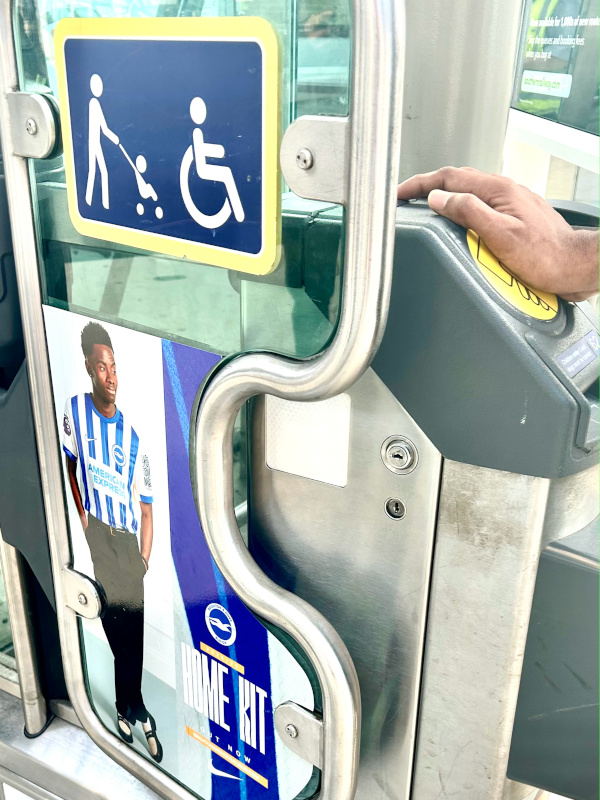
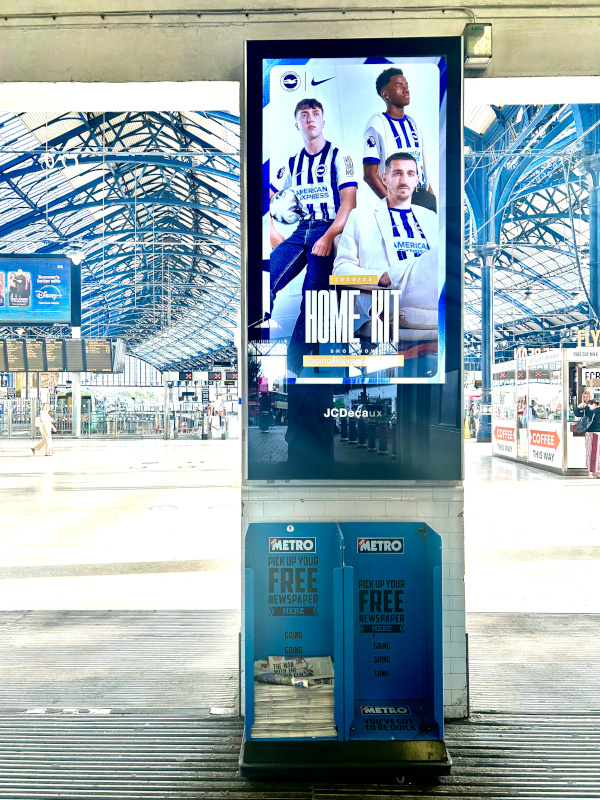
Platform advertising puts a brand in the eyeline of waiting passengers, concourse advertising reaches the wider mix of people simply passing through, and adgates or ticket barrier formats work well because every passenger has to slow down and queue. Adgates catch travellers at the exact moment they tap in or out. MEERKATworks paired adgates with a Transvision screen and digital 6-sheets for a Brighton & Hove Albion campaign at the station, timed around Brighton Pride.
Experiential activations and on-board media
On the train, on-board media can extend to seatback advertising and Wi-Fi login pages.
Larger stations also offer experiential opportunities, such as sampling stands, experiential or pop-up activations, for brands seeking visibility and an interactive experience. For example, the MEERKATs ‘wowed’ commuters and visitors when they planned and bought the huge Motion Screen in Waterloo Station for a visit Louisiana campaign. The creative showcased ways to “spice up your next trip” and worked alongside an exciting experiential space in the main concourse where people could sample Louisiana hot sauces and Tabasco ice cream.
Who you’re reaching: Commuters, leisure and regional audiences
Rail audiences are more varied than you might think; commuters offer a steady, repeat-exposure audience valuable for finance, education, recruitment or local service brands that benefit from frequency, while leisure travellers are more receptive to ideas about days out, attractions and retail. Regional audiences, moving between towns and cities, can be reached with messages tailored to a specific area. City-centre stations are often the busiest single advertising locations in a town, with shoppers and office workers mixing with rail passengers themselves.
Metro train advertising and regional networks
Metro train advertising generally describes regular, urban services dominated by local commuters rather than long-distance travellers; London’s Underground is the obvious UK example. Metro-style networks tend to be best for high-frequency, local awareness. National rail advertising, by contrast, tends to involve longer routes, mixed audiences and a wider catchment. It is generally better suited to broader regional/ national reach.
Train advertising as part of a wider transport campaign
Train advertising can work as a standalone option or as one part of a wider transport advertising strategy. Rail can provide the regional or commuter backbone of a campaign, bus advertising adds street-level visibility in the towns a route passes through and taxi advertising brings a closer, more premium presence in city centres. In London and other major cities, Underground advertising can sit alongside national rail to cover both the metro network and longer-distance arrivals.
Train station advertising costs: What affects pricing
Train station advertising costs vary considerably and there’s no single rate card for the whole network. For a meaningful, geo-targeted campaign at select stations, you’re likely to invest upwards of £5,000. The size of the station matters a great deal: a major city terminus with high-density footfall will require multiple panels for a meaningful campaign, whereas a smaller suburban station may only need a handful of panels to have an impact. Format is another key driver, with static posters typically costing less than digital screens, and higher sums necessary for a large Transvision screen near a departure board or a concourse takeover.
Who should jump on board?
Train advertising suits certain campaigns particularly well. Retail brands often use train station advertising around new store openings or seasonal sales, especially near a shopping destination. Universities and education providers (see the MEERKATs’ work alongside the University of Sussex) use rail formats to reach prospective students during open days or clearing campaigns, often targeting stations near campuses or key commuter lines.
Tourism boards value rail audiences because travellers are already moving and open to ideas about where to go next. Event organisers (such as our recent campaign for Solas Festival) use short, high-impact rail campaigns ahead of a concert, festival or fixture, while finance and recruitment brands lean on the steady, repeat-exposure commuter audience. Regional brands often choose train ads specifically because they want presence in a defined area without paying for reach far beyond it.
How MEERKATworks can help
Planning a train advertising campaign involves choosing the right networks, stations and formats, negotiating with rail media owners, managing production deadlines and potentially tying it into a wider transport advertising strategy. As an independent media planning and buying agency, we aren’t tied to any single rail operator or media owner, so our recommendations are based on what suits your audience and budget. Whether you’re weighing up a single regional network or a national campaign across several operators, we can help shape a plan that has real impact.
Let’s get your campaign on track
Train advertising is popular because it works. You have a captive audience, a fixed location and a message that gets seen again and again. Fancy putting that captive audience to work for your brand? Get in touch with the MEERKATworks team today.